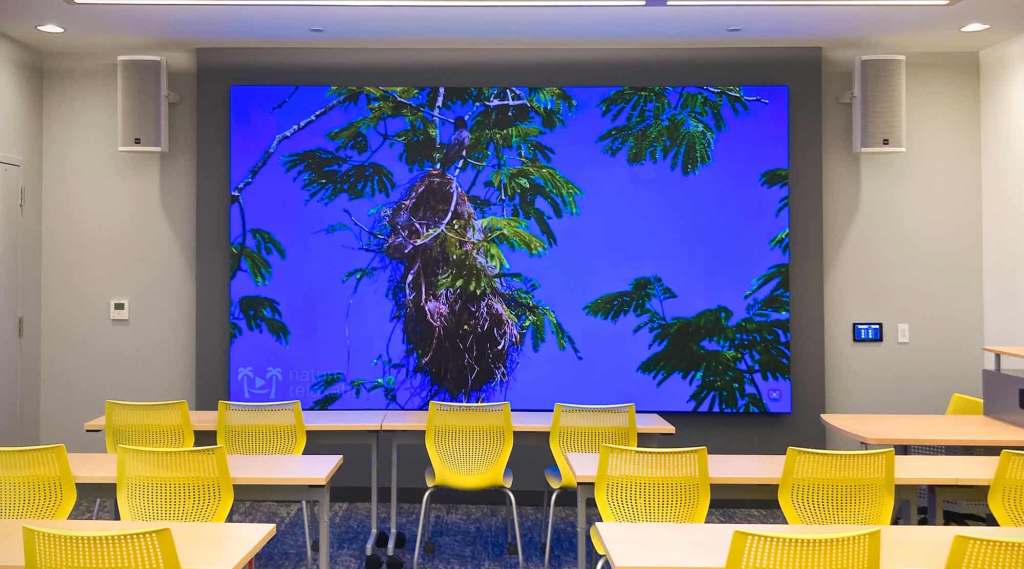
Walk into almost any high-end corporate office today, and there is a good chance the first thing that catches your eye is not the reception desk or the artwork on the wall , it is the large, glowing display commanding the entire feature wall of the lobby. LED video walls have quietly become one of the most recognizable symbols of a modern, serious business.
But here is the honest question most business owners eventually ask: Is this actually worth it for us, or is it just an expensive piece of technology that looks impressive and does little else?
That is exactly what this guide is here to help you figure out.
Understanding What an LED Video Wall Actually Is
Before you can decide whether you want to opt for LED Video Wall Installation in your lobby or not, you need to understand what you are actually buying.
An LED video wall is not simply a very large television. It is a modular display system built from individual LED panels that connect and align together to form one seamless screen. The size, shape, and configuration are not fixed , they are determined by your space, your viewing distances, and what you want to achieve visually.
What makes this technology fundamentally different from a projector or a standard LCD screen is how it produces light. An LED video wall uses direct-view LED technology, meaning the panels themselves generate the image rather than relying on a backlight shining through layers of liquid crystal. The practical result of this is exceptional brightness, rich contrast, and clarity that holds up across wide viewing angles , even in lobbies flooded with natural light from floor-to-ceiling windows.
These systems are also built to run. In a commercial environment where displays may be operating for ten or twelve hours a day, reliability is not a minor consideration. LED panels are engineered for continuous use without the image degradation or color shifting that affects other display technologies over time.
Where LED Video Walls Deliver the Most Value
Not every business lobby genuinely needs an LED video wall. There are situations where a well-placed commercial display or a thoughtfully designed digital signage setup will serve you just as well at a fraction of the cost. Knowing where LED video walls truly earn their place helps you make a decision grounded in reality rather than trend-chasing.
Corporate headquarters and professional services firms , law firms, financial institutions, management consulting companies , often operate in environments where first impressions carry real commercial weight. A client walking into your lobby is quietly forming opinions about your organization before anyone has said a word. A well-executed LED video wall featuring your brand, your work, or even a curated visual experience signals seriousness and investment in a way that very little else can match.
Healthcare facilities have found genuine operational value in the technology. Waiting rooms and main lobbies where patients and visitors spend time benefit from content that informs, directs, and reduces the anxiety that comes with waiting. The same logic applies to hospitality environments , hotels, conference centers, and event spaces where the ambient atmosphere directly shapes the guest experience.
High-traffic retail flagships and showrooms use LED video walls to create immersive product experiences that static printed signage or even standard digital displays cannot replicate.
The common thread is this: if your lobby is a place where people form opinions about your business, an LED video wall gives you direct control over what those opinions are shaped by.
Key Factors to Evaluate Before Making a Decision
There are a few technical considerations worth understanding before you get to the point of signing off on a project.
Pixel pitch is the measurement of distance between individual LED pixels , determining how sharp the image appears at close range. If visitors in your lobby will be standing just a few feet from the display, you need a lower pixel pitch to maintain image clarity. Larger open spaces with greater viewing distances can accommodate a slightly higher pixel pitch without the difference being noticeable.
Lighting in your lobby matters more than most people expect. LED video walls are one of the few display technologies that genuinely hold their own in bright ambient environments. If your space has strong overhead lighting or direct sunlight coming through windows at certain times of day, this technology has a clear practical advantage over projection-based alternatives.
Your building’s infrastructure needs an honest assessment before installation begins. The structural wall needs to support the mounting system, power provisions need to meet the system’s requirements, and cable routing needs to be planned carefully. This is not work you want done haphazardly , a proper site survey by experienced AV professionals is not optional; it is the foundation of a successful installation.
Content management is the part that gets overlooked most often in early planning conversations. The display is only as useful as what you put on it. You need a content management system your team can actually use , one that lets you schedule updates, rotate messaging, and adapt to changing needs without requiring a technical specialist every time something needs to change.
The Business Case: What You Are Actually Investing In
LED video walls cost more upfront than most alternative display solutions. That is simply true, and there is no point in softening it.
What changes the calculation is longevity. Quality LED panels are rated for well over 100,000 hours of operation. Maintenance needs are low. Component replacement over the life of the system is minimal. When you account for the total cost of ownership rather than the purchase price alone, the economics look considerably different over a five or ten-year horizon.
There is also something harder to quantify but genuinely important. The environment in which you conduct business shapes how your clients perceive your organization. Businesses that invest in professional audio video installation understand this better than most , because they have seen firsthand how a lobby that reflects care, investment, and visual sophistication builds credibility in a way that is difficult to put a dollar figure on. But anyone who has ever walked into an impressive space and thought more highly of the people inside it understands exactly what that is worth.
Why Innoface Systems Is the Right Partner for Your LED Video Wall Installation
Innoface Systems has spent years building a reputation as the most reliable commercial AV integration company in the DC, Maryland, and Virginia region , and beyond, with active project work in Atlanta and Tampa as well.
What sets us apart in practice is that we handle everything. Site survey, system design, infrastructure assessment, panel installation, content management setup, and ongoing support , all of it is managed by certified professionals who have done this work in real commercial environments, not just theoretical ones. There are no handoffs to subcontractors unfamiliar with the project history.
To schedule a consultation, contact us at 1-877-721-4040. Get in touch with us today!
Frequently Asked Questions
Q1: How long does a commercial video wall installation typically take?
Most standard lobby installations wrap up within two to five business days. That window covers mounting, panel assembly, cabling, and full system testing. Larger or more complex configurations may take longer, which is something your AV integrator will clarify during the site survey before work begins.
Q2: Does the internal team update the content without calling in a technician every time?
Yes, and this is a priority worth discussing early in the planning process. Professional LED video wall systems are paired with content management platforms designed for non-technical users. Your integrator will configure the system and walk your designated team members through how to manage it independently on an ongoing basis.
Q3: If our lobby isn’t particularly large, is an LED video wall still a realistic option?
More often than not, yes. The modular nature of LED video wall systems means they can be scaled and configured to suit compact spaces without losing visual impact. The key is working with an experienced integrator who will assess your specific dimensions and design a solution that works with your space rather than against it.