By Ivan Collins, President and CEO, Innoface Systems, Inc.
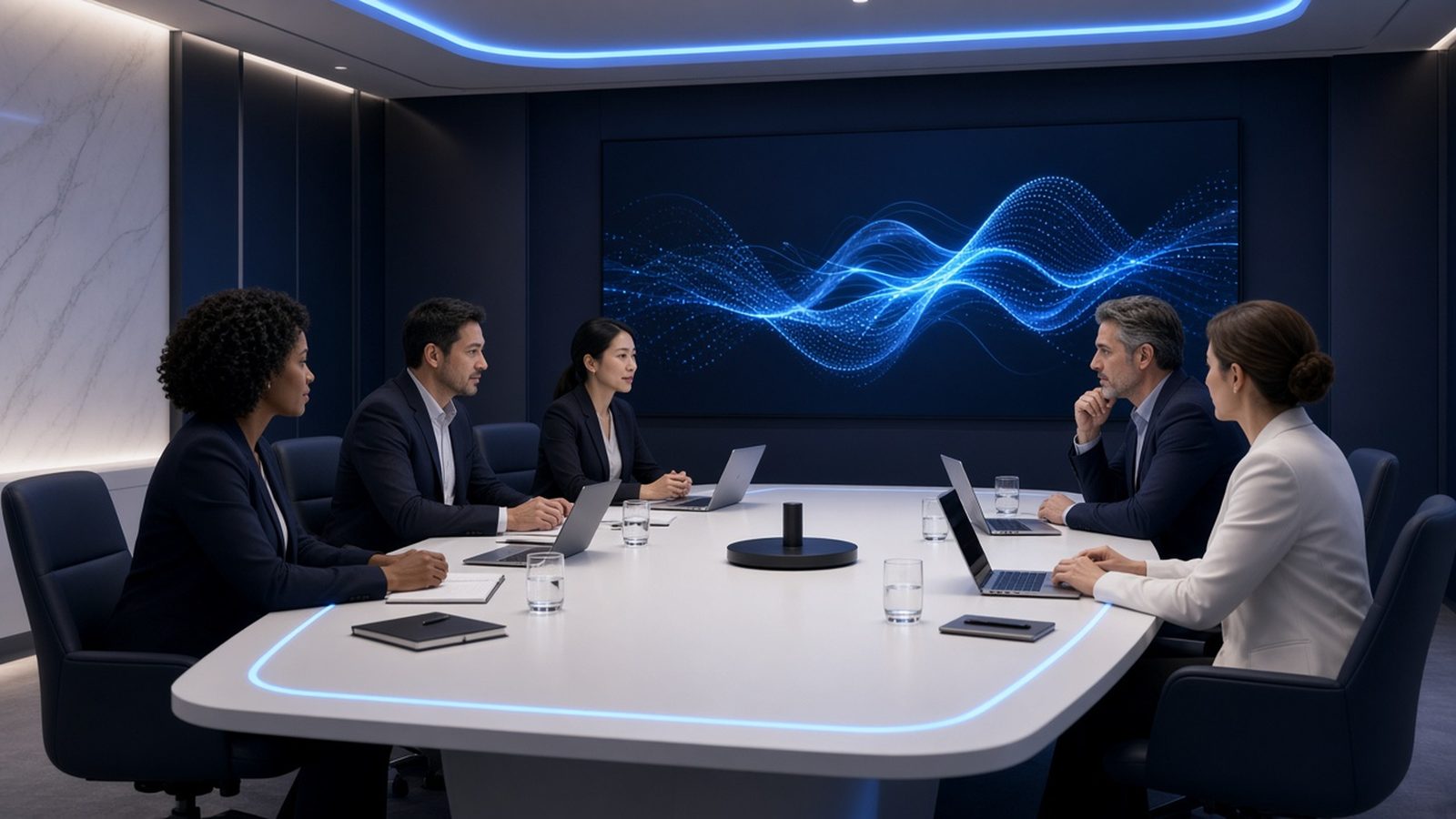
For decades, conference room technology has helped people see, hear, present, and communicate. The AI conference room of the future will do much more.
For decades, conference room technology has primarily focused on helping people see, hear, present, and communicate.
The conference room of the future will do much more.
The next generation of meeting spaces will not simply facilitate conversations. They will understand them, organize them, act on them, retrieve information in real time, and help organizations turn conversations into decisions and decisions into action.
Artificial intelligence is already beginning to change how meetings are captured and summarized. But transcription is only the beginning.
At Innoface Systems, Inc., we believe the long-term evolution of the conference room will be toward an intelligent environment—one where the AV system becomes an active participant in the meeting itself.
Here are some of the technologies that could define that future.
1. AI Meeting Intelligence: From Conversation to Action
Today's AI can already transcribe meetings and generate summaries. The next evolution will go considerably further.
Imagine completing a 45-minute executive meeting and, within minutes, the system has:
- Produced a complete searchable transcript
- Identified major decisions
- Extracted action items
- Assigned responsibilities
- Identified deadlines
- Distributed relevant information to each participant
- Drafted follow-up emails
- Updated project-management and CRM platforms
- Generated new workflows based on decisions
- Recommended changes to existing procedures
- Drafted policies or internal documentation
- Scheduled follow-up meetings
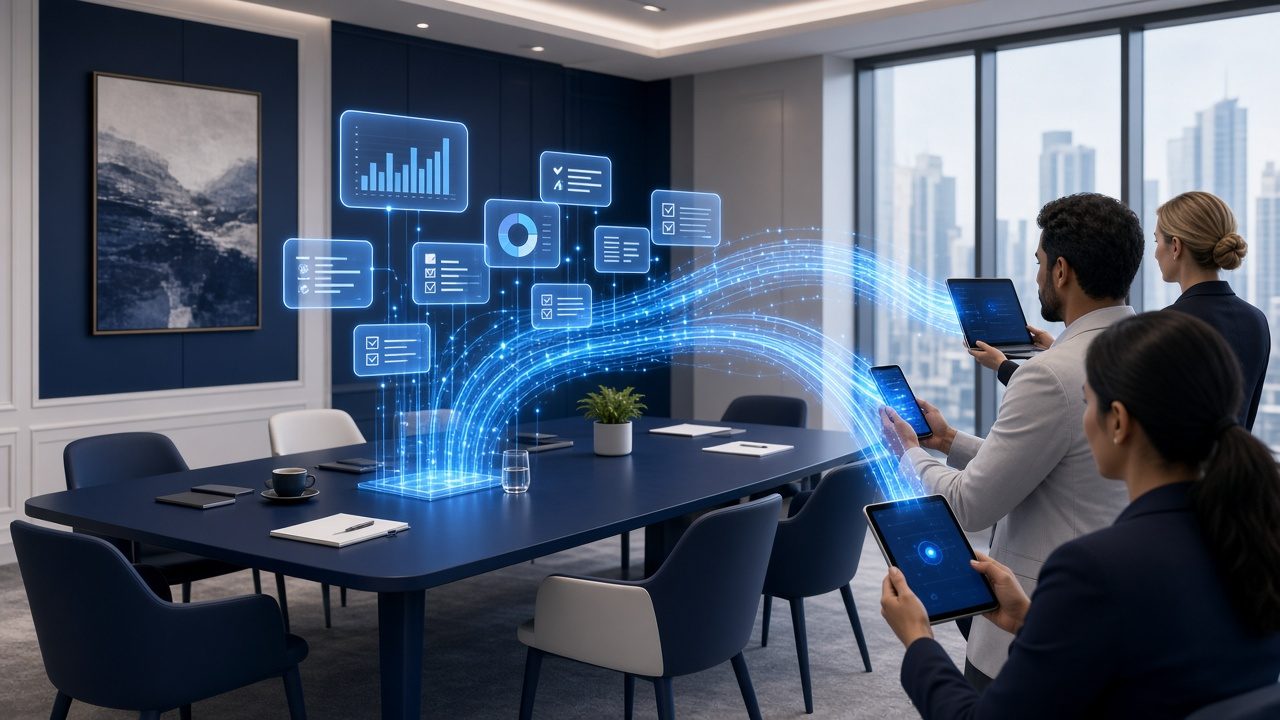
Most importantly, everyone would not necessarily receive the same information.
The CFO might receive the financial implications of the discussion. Operations could receive implementation requirements. Sales could receive customer-related actions. An executive could receive a concise decision summary.
Instead of spending the days following a meeting determining what was decided and who needs to do what, much of that administrative work could be completed before participants return to their desks.
The output of a meeting would become as important as the meeting itself.
2. Organizational Authority Recognition
One of the more interesting possibilities is AI understanding not just what was said, but the organizational significance of who said it and how others responded.
Consider a CEO saying:
"Beginning next quarter, all projects over $250,000 will require executive approval."
The system could recognize that this was not simply another comment in the transcript. It was an executive directive.
If nobody challenged or modified the instruction during the meeting, AI could identify it as a decision requiring implementation.
The system could then flag affected departments, identify existing procedures that conflict with the directive, generate proposed workflow changes, and prepare documentation for human approval.
This could create an entirely new category of meeting intelligence: Organizational Authority Recognition.
Importantly, AI should not literally determine that one person's ideas matter more than another's. Instead, organizations could establish predetermined authority structures, approval levels, and governance rules that allow the system to distinguish between brainstorming, recommendations, objections, decisions, and authorized directives.
AI would understand not simply the words spoken—but their organizational context.
3. Real-Time Absence Response Technology (RART)
Meetings frequently reach a point where someone says:
"We really need John here to answer that."
Today, the discussion usually stops, someone sends John an email after the meeting, and the issue gets added to another meeting.
That could disappear.
We envision a concept called Real-Time Absence Response Technology, or RART.
If the meeting reaches a question that requires information from someone who is not present, AI could identify the appropriate person and request the information immediately.
For example:
"What is the expected delivery date for the equipment?"
The system recognizes that the procurement manager owns that information.
Within seconds, the procurement manager receives:
"The executive project meeting is currently discussing the Smith project. What is the confirmed equipment delivery date?"
The response comes back:
"October 16."
The conference room display automatically shows:
Procurement Response — Expected Delivery: October 16
The meeting continues.
In more advanced implementations, AI could determine whether the absent participant needs to temporarily join the meeting and send an invitation with a one-click option to enter directly into the relevant discussion.
Meetings would no longer have to stop simply because the person with the answer isn't in the room.
4. Automatic Document and Content Display
Screen sharing may eventually feel surprisingly outdated.
Instead of someone searching through folders while everyone waits—
"Give me a second. I know I have that document somewhere..."
—the room itself could understand the conversation.
If someone says:
"Let's look at last quarter's Atlanta sales numbers."
The system retrieves the authorized report and displays it.
Someone asks:
"What did the original floor plan look like?"
The architectural drawing appears.
"Can we see the video from the previous presentation?"
The video is automatically located and queued.
The AV system could intelligently retrieve and route:
- Documents
- Presentations
- Spreadsheets
- Drawings
- Images
- Videos
- Websites
- Dashboards
- CRM records
- Project documentation
- Previous meeting content
Instead of users operating the AV system, conversation itself becomes part of the control interface.
Traditional touch panels would still have a place, but users may increasingly control rooms simply by speaking naturally.
5. Classified Conversation Recognition
One of the most consequential applications could emerge in government, defense, intelligence, healthcare, legal, financial, and other highly secure environments.

Future AV systems could incorporate Classified Conversation Recognition or, more broadly, Sensitive Information Recognition.
Rather than relying entirely on users to recognize when a conversation has exceeded the security level of the environment, an authorized local AI system could monitor for predetermined classifications or sensitive-information conditions.
In a government environment, for example, if a conversation begins approaching a classification level not permitted within that particular space, the system could issue an immediate warning.
Depending upon security policies, it could then automatically disable specific capabilities such as:
- Microphones
- Cameras
- Recording
- Transcription
- External conferencing
- Wireless connectivity
- Content sharing
In the most restrictive environments, the entire AV communications system could terminate according to predetermined security policies.
For a true SCIF or other classified environment, this would require highly specialized, accredited architecture, local processing, strict access controls, approved equipment, and security policies established by the appropriate authority. Consumer cloud AI would clearly not be appropriate.
The broader concept, however, is significant:
The room could eventually help enforce its own information-security boundaries.
6. AI-Controlled Cameras That Understand the Meeting
Today's intelligent cameras can already perform functions such as speaker framing and participant tracking.
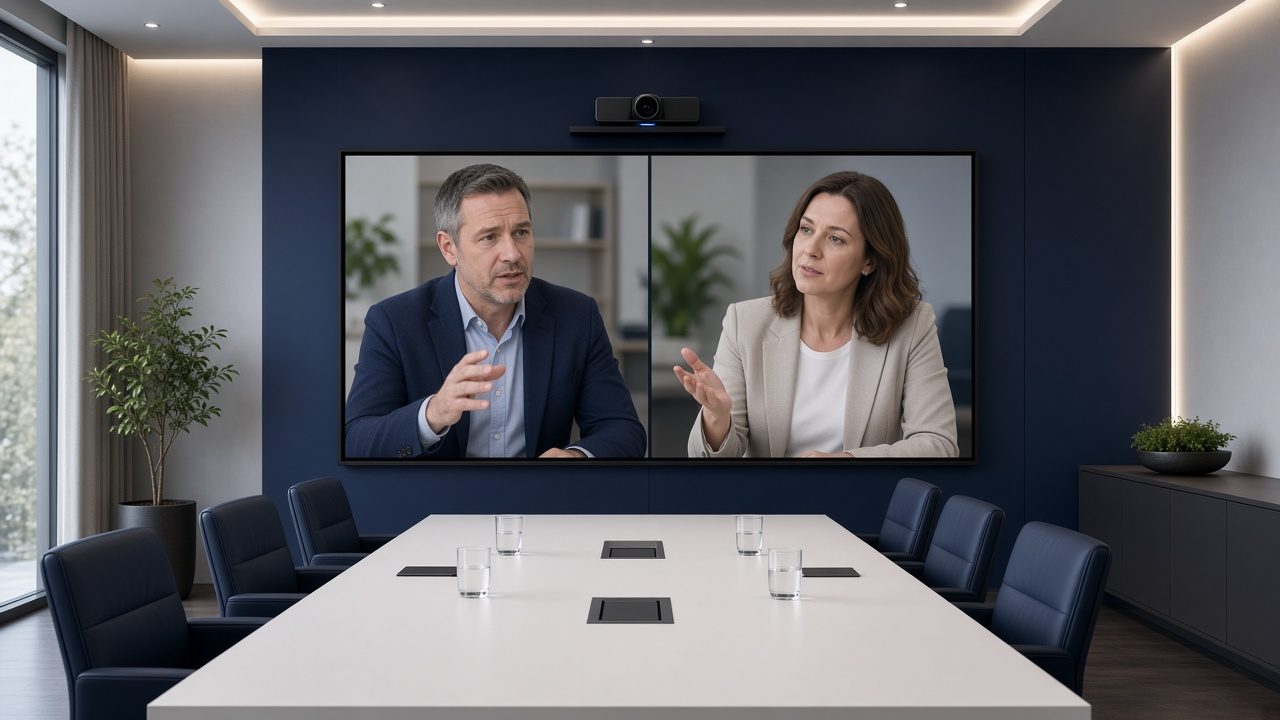
Future systems could understand the meeting context itself.
During a presentation, the system may determine that the remote audience needs to see the presenter.
During a debate, it could automatically create a split view showing both participants.
When someone references an object or demonstration, another camera could automatically frame it.
When several participants begin discussing something together, the system could transition to a group shot.
Rather than simply tracking whoever is making noise, camera direction could become context-aware production.
The conference room effectively gains its own automated video director.
7. Intelligent Audio That Understands Intent
Audio systems could evolve in a similar direction.
Rather than treating every sound equally, AI-assisted audio could continuously understand what is happening within the room.
The system could differentiate between:
- Active speakers
- Side conversations
- HVAC noise
- Keyboard typing
- Paper movement
- Participants speaking from different areas
- Questions from the audience
- Remote participants
- Intended versus unintended speech
Beamforming microphones, DSP platforms, speaker systems, and AI could work together dynamically.
The objective would no longer simply be "make the microphone louder."
It would be:
Determine what everyone needs to hear and deliver it clearly.
8. The Conference Room Becomes an Organizational Memory
This may ultimately be one of the biggest changes.
Organizations lose enormous amounts of knowledge because decisions happen verbally.
Someone remembers one version of the conversation. Someone else remembers another. Six months later, nobody remembers why a decision was made.
Future meeting environments could create a secure, permission-based organizational memory.
Imagine asking:
"Why did we decide against expanding the Atlanta office?"
Instead of searching through emails, AI could locate the relevant meetings and respond:
"The expansion was discussed during three executive meetings in March and April. The final decision was made April 17 because projected occupancy did not justify the lease expense. The CFO recommended revisiting the decision when headcount exceeds 85 employees."
The organization would retain not only the decision—but the reasoning behind it.
9. Predictive Meeting Intelligence
Eventually, the system may begin identifying problems before participants do.
Imagine discussing a project schedule when the room's AI recognizes:
"The proposed installation date conflicts with the delivery schedule discussed during Monday's procurement meeting."
Or:
"This proposal exceeds the budget approved during the August 12 finance meeting by approximately 18%."
Or:
"Three projects discussed today depend on the same engineering resource during the same week."
At that point, AI is no longer documenting the meeting.
It is helping the organization think across meetings.
10. Automatic Meeting Preparation
The intelligent conference room could begin working before anyone walks through the door.
When an executive team enters for a quarterly operations meeting, the system already knows the agenda.
- Relevant dashboards are loaded.
- Documents are indexed.
- Previous action items are available.
- Remote participants are identified.
- Outstanding decisions from the previous meeting are summarized.
The room may open with:
"There are four unresolved action items from your previous operations meeting. Two have been completed, one is overdue, and one requires a decision today."
Instead of spending the first 15 minutes figuring out where the last meeting ended, participants begin where the organization actually left off.
11. Environmental Intelligence
The physical room itself will also become more responsive.
Occupancy sensors, cameras, microphones, lighting controls, HVAC systems, shades, displays, and room scheduling platforms could operate as one intelligent environment.
The system could automatically adjust lighting for videoconferencing, modify microphone processing based on occupancy, optimize camera framing, change temperature based on room utilization, activate only the equipment needed for the meeting, and power everything down when the space becomes vacant.
The result could be better meetings while simultaneously reducing energy consumption and unnecessary equipment usage.
12. The End of the "AV System" as We Know It
Perhaps the biggest change will be conceptual.
Today, users walk into a conference room and operate technology.
- They select sources.
- They route displays.
- They adjust cameras.
- They launch meetings.
- They share documents.
- They control volume.
The conference room of the future will increasingly do these things itself.
You may simply walk into the room and say:
"Start the project review."
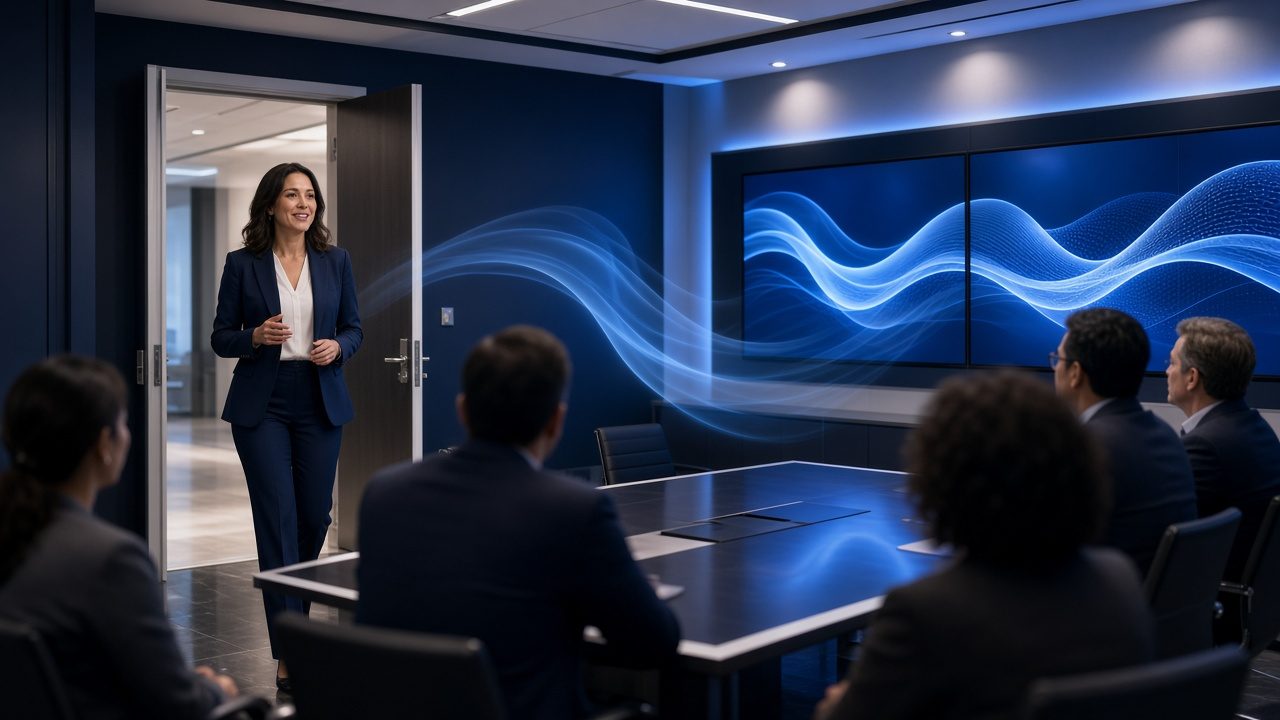
The system recognizes the participants, launches the appropriate meeting, configures the cameras and microphones, loads the agenda, retrieves relevant documents, connects remote attendees, adjusts the room environment, and begins capturing authorized meeting intelligence.
At that point, the technology becomes almost invisible.
And that is arguably the ultimate goal of professional AV.
The Future of AV Isn't Just Better Hardware: It's the AI Conference Room
Displays will continue getting larger. LED pixel pitches will continue getting smaller. Cameras will improve. Microphones will become more intelligent. Processing will become more powerful.
But the most significant transformation may have very little to do with any individual piece of hardware.
It will be the intelligence connecting everything together.
The conference room is evolving from a place where technology supports a meeting into an environment that can potentially understand the meeting, respond to it, preserve its knowledge, and help execute what happens next.
For AV integrators, that means our role will evolve as well.
The future will require more than installing displays, speakers, microphones, cameras, and control systems. It will require integrating AV with artificial intelligence, cybersecurity, enterprise data, building automation, collaboration platforms, organizational workflows, and information-governance policies.
The conference room of the future won't simply connect people.
It will connect conversations to action.
Innoface Systems, Inc. designs commercial audio-visual environments for organizations preparing for the next generation of communication and collaboration technology.
Contact Innoface Systems, Inc. at 1-877-721-4040 or info@innofacesystems.com to discuss how today's AV technology can prepare your organization for the meeting spaces of tomorrow.
Ivan Collins is President and CEO of Innoface Systems, Inc.